
Background extras in AI-generated American Revolution fanfic
Weekly digest, February 28, 2026

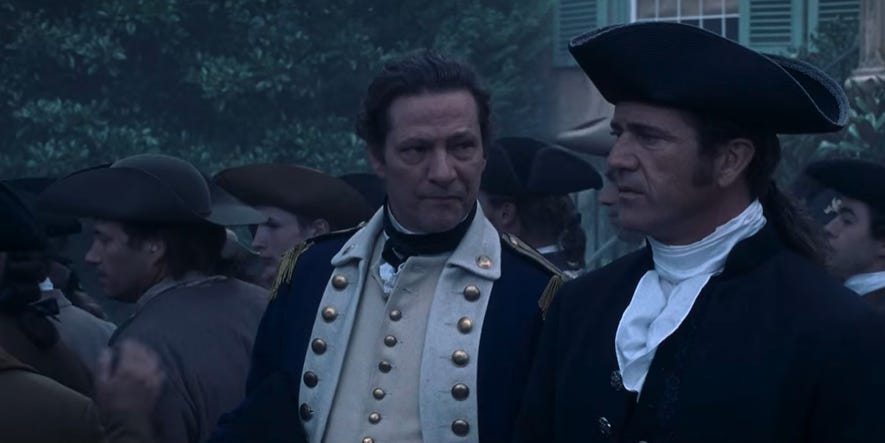
This week resulted in a nicely varied tranche—that’s what we’re calling batches of documents now, right? I’m also glad to say I’m still slowly bouncing back physically and mentally, an encouraging sign of which was a good little week of blogging in between all the work and family commitments. Hope y’all enjoy.
Apropos
I may have shared this quotation before, but as I’ve got several items about historical movies below, it felt, well, apropos:
When a book appears displaying a doubtful portrait of Queen Elizabeth, it will generally be found that about six other historical students are moved to publish about six other versions of Queen Elizabeth at the same moment. We can buy Mr. Belloc’s book on Cromwell, and then Mr. Buchan’s book on Cromwell; and pay our money and take our choice. But few of us are in a position to pay the money required to stage a complete and elaborately presented alternative film-version of Disraeli. The fiction on the film, the partisan version in the movie-play, will go uncontradicted and even uncriticized, in a way in which few provocative books can really go uncontradicted and uncriticized. There will be no opportunity of meeting it on its own large battlefield of expansive scenario and multitudinous repetition. And most of those who are affected by it will know or care very little about its being brought to book by other critics and critical methods. . . . A false film might be refuted in a hundred books, without much affecting the million dupes who had never read the books but only seen the film.
—GK Chesterton, “About the Films,” 1936
What’s going on
Of interest
At The History Quill, a resource for authors of historical fiction, guest writer Jack Shannon offers tips on how to write realistic war scenes, with special reference to the work of Bernard Cornwell. A short list offering a good place to start, though I’d argue that one of the most realistic things you can do—in a modern war story, anyway—is not make your character’s actions significant.1
Jason M Baxter is in Tuscany working on his translation of the final canticle of Dante’s Comedy. In this delightful and wide-ranging post, he describes walking the hills above Florence, some of the distinctive character of the city and its people, and what we can see of all this in Dante.
I’m always on the lookout for new material I can talk about or show the students in my Technology & Culture humanities class. This new Fern documentary on DMT is too long and a little too loosely about “medicine” to show in my class module on medical tech, but it got me thinking about the curious role of psychedelics in the life of Ernst Jünger. Here’s a short Compact review of a collection of Jünger’s writings on the subject a few years ago:
Even as Jünger refuses all moralization of psychoactive substances, he also declines to present them as a panacea. Like war, drugs can be both illuminating and destructive; the experiences they offer us demand respect, not trivializing celebration. Chemically altered states of mind don’t represent for Jünger, as they did for some of his contemporaries in the late 20th century, a political solution to the ills of modernity. Instead, his experiments with drugs are of a piece with the enterprise of individual autonomy he famously identifies, in his 1977 novel, Eumeswil, with the figure of the “anarch.” Jünger’s anarch isn’t an anarchist: He doesn’t seek to destroy authority. Instead, as he writes “the special trait that makes me an anarch is that I live in a world that I do not take seriously.” The anarch hasn’t been expelled from society; he has “expelled society from himself.” Drugs offer one means of seeking this higher state of consciousness, but precisely because of their immense potency, their dangers must also be recognized.
It is instructive to see the places where your heroes can offer insight but into which you may not and will not follow them.
Speaking of the intersection of technology and culture, at Law & Liberty Nadya Williams reviews Joel J Miller’s new book The Idea Machine, a history of the book as both software and hardware:
people have always had ideas about a wide range of topics and concepts, from the more artistic to the more practical. All advancements begin with ideas, inventions, and experiments that snowball into something greater and more significant. Sometimes these ideas are quick “aha” moments, but more often they marinate for years, maybe even decades. So why do some ideas, whether in antiquity or more recently, spread across the globe while others are forgotten? The answer does not lie merely in the quality of these ideas, as plenty of great ones have been forgotten or even lost. Rather, the answer is: books. It is the ideas that have been written down in books—especially popular books—that have exploded to influence our world in myriad ways. In the process, the “installation” of these ideas in our brains becomes the software of our lives, just as the physical material of the books themselves serves as the hardware.
I got a copy of Joel’s book for Christmas and very much look forward to reading it.
In case you missed it, director Darren Aronofsky (Requiem for a Dream, The Wrestler, among others) is responsible for “On This Day… 1776,” a series of short “films” about the American Revolution. I put “films” in scare quotes because the project is entirely AI-generated. You’ll be shocked to learn that it’s not very good. For a detailed breakdown with maximum sardonic outrage from a period expert, here’s reenactor Brandon Fisichella on YouTube.
Speaking of bad work by hip modern filmmakers, apparently the new Wuthering Heights film isn’t good, either. Here’s Alexander Larman on the movie’s gross miscalculations and artistic failures, and, at The Critic, Beatrice Scudeler with a compelling argument that Emily Brontë’s novel is yet another victim of the corrosive effect of fanfic:
Fanfiction is at its core unintentional parody. While proper parody takes the tropes of the source material and exaggerates them to reveal or critique an aspect of the original story, fanfiction takes those genre conventions to be the story in and of themselves. A concrete example: a number of Jane Austen retellings, from my personal favourite Austenland (2013) to the more recent, brilliantly titled French film Jane Austen Wrecked My Life (2025), take the aesthetic sign posts of what makes an “Austen story” (bonnets, dancing, Regency breeches…) and insert them in a contemporary context to examine what has and hasn’t changed in our culture since Austen’s times. They’re entertaining and well-executed parodies.
On the other hand, a show like Bridgerton capitalises on our familiarity with the Regency setting but fails to say anything interesting about either Austen’s society or our own. What makes it “Austenesque” is not the meat of the story but the visuals. It’s a form of fanfiction because it has nothing new or interesting to say about the material which inspires it. And unlike parody, which tends to be highly self-aware, it has the fatal flaw or taking itself painfully seriously. Wuthering Heights is basically dark academia Bridgerton: minus the pastel petticoats, plus Margot Robbie’s busty milkmaid ren faire dresses.
Both Larman and Scudeler note that Emerald Fennell, the filmmaker behind Wuthering Heights, doesn’t understand the book and doesn’t apparently care to. The mortal sin of adaptation, and of much modern culture.
Over on YouTube, writer and film critic Thomas Flight insightfully considers the ways, both good and bad, that filmmakers use extras.
Finally, James Lileks covers a recent kerfuffle concerning whether or not Reese’s has adulterated the traditional ingredients of the Reese’s Cup. Like him, the Reese’s Cup is one of the only candies I really intensely care about and, also like him, the plain old original Reese’s Cup is its only permissible form:
Let me make an unpopular point: if you are expecting a full-on Reese’s experience from the permutations, you’re asking too much of life. Every alteration is a diminution. Am I saying that a Reese’s enrobed in white chocolate - sorry, cohesive albino binding fluid - is not a Reese’s Peanut Butter cup? I am saying exactly that. As long as the original is unchanged, I don’t care if they encrapify the heart-shaped one that bleeds sludge.
Hear hear. Enough with the Reese’s Cups stuffed with fudge (why?), potato chips (what?), and broken Reese’s Pieces (what are we even doing?).
The latest on the blog
I reflected on the slow disappearance of the Southern accent and my regret over not having more of an accent myself.
I reviewed State of Siege, a 1956 thriller by Eric Ambler in which an English engineer finds himself trapped at the center of a revolution in southeast Asia. Short version: it’s excellent.
I reflected on the hellscape of nastiness and ignorance that is present-day Goodreads.
From the blog archives
For more of Chesterton’s perspective on bad historical movies, with my commentary and some recent examples, here’s a post I wrote several years ago.
Speaking of bad movies, especially bad adaptations of novels, here’s a post from last summer about the problem presented when filmmakers aren’t just ignorant but actively contemptuous of their source material.
To end on a good movie, here’s a post from just before I started this Substack about the excellence of Spider-Man 2 and the role of excellence—in the sense of virtue—in its story.
Currently reading
The Mills of the Gods, by Tim Powers
The Way of Dante, by Richard Hughes Gibson
Orthodoxy, by GK Chesterton
Hitler’s People: The Faces of the Third Reich, by Richard J Evans
The Lost Language of Oysters, by Alexander McCall Smith
King Arthur and His Knights of the Round Table, by Roger Lancelyn Green
Recently acquired
The Divine Comedy, by Dante, trans. Charles Singleton (one-volume edition)
How to Find Happiness, by Cicero, trans. and ed. Katharina Volk (excerpted from On the Greatest Good and Evil)
Until next time
As always, I hope y’all have found something interesting or at least entertaining to read and think about here. If you need me, I’ll be driving to QT for some Reese’s Cups. Thanks for reading!
This does not, however, mean making them meaningless.